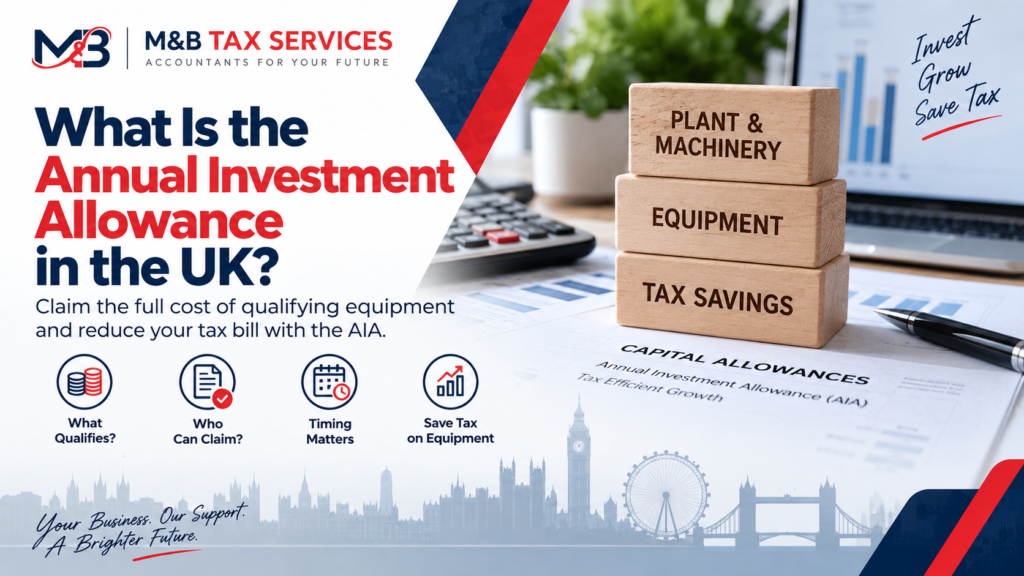
What Is the Annual Investment Allowance in the UK?
The Annual Investment Allowance (AIA) is a capital allowance that lets businesses deduct the full cost of qualifying plant and machinery from their taxable profit

The Annual Investment Allowance (AIA) is a capital allowance that lets businesses deduct the full cost of qualifying plant and machinery from their taxable profit

The Annual Investment Allowance (AIA) is a capital allowance that lets businesses deduct the full cost of qualifying plant and machinery from their taxable profit in the year of purchase.

An accountant is a financial professional who helps individuals and businesses manage their finances, prepare their accounts, and meet their tax obligations. In practice, what an accountant does for a

One of the biggest advantages of operating through a limited company is the ability to control how and when you take money out of the business. Done correctly, this significantly

A UTR number is a Unique Taxpayer Reference. It is a 10-digit number that HMRC uses to identify you for tax purposes. Every person or business that files a Self

The Construction Industry Scheme (CIS) places a set of obligations on contractors who pay subcontractors for construction work in the UK. As a contractor, you are responsible for verifying subcontractors

Every self-employed person in the UK pays tax on their profits. The lower your taxable profit, the less tax you pay. There are entirely legal ways to reduce that profit
A P60 is an end-of-year tax summary that your employer gives you after each tax year ends on 5 April. It shows your total earnings and the total tax and

Making Tax Digital (MTD) is HMRC’s programme to modernise the UK tax system by requiring businesses and individuals to keep digital records and submit tax information to HMRC through compatible

HMRC charges automatic penalties for late Self Assessment returns and late tax payments. These penalties apply whether or not you owe any tax, and they accumulate quickly if left unaddressed.
A UTR number is a Unique Taxpayer Reference. It is a 10-digit number that HMRC uses to identify you for tax purposes. Every person or
Every self-employed person in the UK pays tax on their profits. The lower your taxable profit, the less tax you pay. There are entirely legal
HMRC charges automatic penalties for late Self Assessment returns and late tax payments. These penalties apply whether or not you owe any tax, and they
The Construction Industry Scheme (CIS) places a set of obligations on contractors who pay subcontractors for construction work in the UK. As a contractor, you

You do not have to register for the Construction Industry Scheme (CIS) as a subcontractor. Registration is optional. But if you choose not to register,
If you work in construction as a subcontractor, you have probably heard both terms. CIS and Self Assessment are two separate systems, but they are connected.
A P60 is an end-of-year tax summary that your employer gives you after each tax year ends on 5 April. It shows your total earnings

You must register for VAT when your taxable turnover exceeds £90,000 in any rolling 12-month period. This is the VAT registration threshold for 2024/25. It is not based on your financial year.

One of the most common questions new limited company directors ask is how to actually get money out of their company. The answer matters because doing it wrong costs you significantly more tax than doing it right.
Making Tax Digital (MTD) is HMRC’s programme to modernise the UK tax system by requiring businesses and individuals to keep digital records and submit tax

Most businesses in Redditch choose a VAT scheme when they first register and never revisit it. That is a costly mistake.
An accountant is a financial professional who helps individuals and businesses manage their finances, prepare their accounts, and meet their tax obligations. In practice, what

Registering a limited company in the UK is straightforward and costs just £50 online. The process takes as little as 24 hours once you have

The short answer is no, you are not legally required to use an accountant when starting a business in the UK. But whether you need one is a different question entirely. The short answer is no, you are not legally…

In most cases, yes. If you receive rental income in the UK, you are required to declare it to HMRC through a Self Assessment tax

Claiming the right expenses is one of the most effective ways to reduce your rental income tax bill. Yet many landlords either overclaim (which HMRC

If you receive rental income in the UK, you are required to pay Income Tax on your profit. How much you pay depends on your