
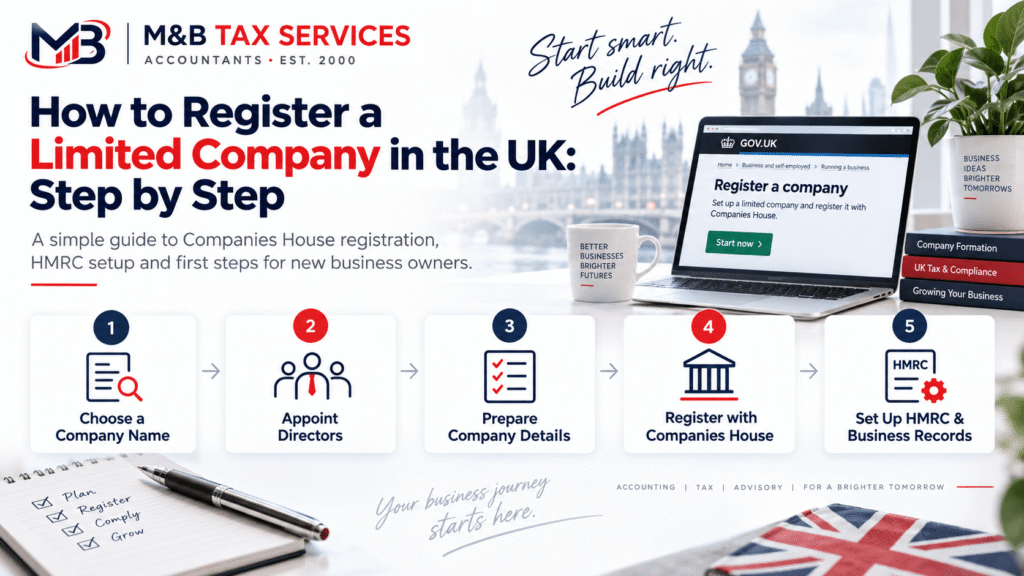
Registering a limited company in the UK is straightforward and costs just £50 online. The process takes as little as 24 hours once you have the information ready.
The decisions you make at registration, including your company name, share structure, and director details, have long-term consequences. Getting them right from the start is much easier than amending them later. This guide walks you through every step.
Before You Register: Decisions to Make First
1. Confirm your company name
Your company name must be unique and not too similar to an existing registered company. You can check name availability on the Companies House register at beta.companieshouse.gov.uk.
Your name must end in ‘Limited’ or ‘Ltd’ (or the Welsh equivalents if you are registering in Wales). It cannot contain certain sensitive words without approval, such as ‘Royal’, ‘Bank’, or ‘Institute’.
Also check that the domain name and social media handles for your chosen name are available, as these are important for your online presence.
2. Choose your registered office address
Every limited company needs a registered office address in the UK. This is where Companies House and HMRC send official correspondence. It appears on the public Companies House register.
If you work from home and do not want your home address publicly visible, a virtual office address is the standard alternative. M&B Tax Services provides a registered office address service for this purpose.
3. Decide on directors
A limited company must have at least one director. Directors are responsible for running the company and ensuring it meets its legal obligations. A director must be at least 16 years old and cannot be an undischarged bankrupt.
For most small businesses, the founder is the sole director. You can add additional directors at any time after registration.
4. Decide on shareholders and share structure
A limited company must issue at least one share. Most simple companies issue ordinary shares with equal voting rights and dividend entitlement.
For a single-person company, a common structure is to issue 100 ordinary shares of £1 each to the founder. This makes it easy to work with percentages if you bring in a co-founder or investor later.
If you plan to issue shares to a spouse or family member for income tax planning purposes, take advice before registration. HMRC scrutinises share arrangements between connected persons closely.
5. Prepare your SIC code
A Standard Industrial Classification (SIC) code describes the nature of your business. You select one or more from a list when you register. Companies House publishes the full list. Choose the code that most accurately describes what your company does.
How to Register: Step by Step
Step 1. Go to the Companies House online registration service. Visit start.companieshouse.gov.uk to use the online incorporation service. You will need a Government Gateway account or can create one during the process.
Step 2. Enter your company name. Type your chosen name and check it is available. Companies House checks automatically for identical and very similar names.
Step 3. Enter your registered office address. Provide the full address. This must be a physical address in the UK, not a PO box. Confirm which country the company is registered in (England and Wales, Scotland, or Northern Ireland).
Step 4. Add director details. Enter each director’s full name, date of birth, nationality, occupation, and residential address. The residential address is kept private on the public register. A separate service address (such as the registered office) can be shown publicly instead.
Step 5. Set up your share structure. Enter the number of shares being issued, the class of shares, their nominal value, and who holds them. For a simple structure, issue 100 ordinary shares of £1 each to yourself.
Step 6. Add your SIC code. Select the SIC code or codes that describe your business activity.
Step 7. Review and submit. Review all details carefully before submitting. Errors are possible to correct after registration but take time and cost money. Pay the £50 registration fee by debit or credit card.
Step 8. Receive your certificate of incorporation. Companies House typically issues the certificate of incorporation within 24 hours for online applications. This confirms your company exists and includes your company number.
What Happens After Registration
Register for Corporation Tax
You must notify HMRC that your company exists within three months of starting to trade. Register for Corporation Tax online through HMRC’s Government Gateway. HMRC will send you a Unique Taxpayer Reference (UTR) for the company, which you need to file Corporation Tax returns.
Open a business bank account
A limited company must have its own bank account, separate from your personal finances. Company money belongs to the company, not to you personally. Mixing personal and business finances creates accounting problems and can cause legal issues.
Register for PAYE if you pay yourself a salary
If you plan to pay yourself a salary as a director, you must register as an employer with HMRC and set up payroll before your first payday.
Register for VAT if required
If your company’s taxable turnover exceeds £90,000 in any rolling 12-month period, you must register for VAT. You can also register voluntarily below this threshold.
Set up bookkeeping
You are legally required to keep accurate financial records for your limited company. These records must be kept for at least six years. Cloud accounting software such as Xero or QuickBooks makes this straightforward.
File your first confirmation statement
Every limited company must file a confirmation statement with Companies House at least once a year. The first one is due within 12 months of incorporation. The filing fee is £34 online.
Key Dates and Deadlines for New Limited Companies
| Deadline | What You Must Do |
| Within 3 months of trading | Register for Corporation Tax with HMRC |
| Before first payday | Register for PAYE if paying a salary |
| When turnover exceeds £90,000 | Register for VAT |
| Within 12 months of incorporation | File first confirmation statement |
| 9 months after company year end | File annual accounts with Companies House |
| 12 months after company year end | File Corporation Tax return with HMRC |
| 9 months and 1 day after company year end | Pay Corporation Tax owed |
Common Mistakes When Registering a Limited Company
- Choosing a name that is too similar to an existing company and receiving a rejection after the application is submitted
- Using a home address as the registered office without realising it becomes publicly visible on Companies House
- Issuing shares incorrectly and needing to restructure later, which has tax implications
- Failing to register for Corporation Tax within the three-month deadline and receiving a penalty
- Not opening a dedicated business bank account and mixing personal and business funds
- Missing the first confirmation statement deadline
Frequently Asked Questions
How much does it cost to register a limited company in the UK?
Registering a limited company online through Companies House costs £50. Paper applications cost £71 and take longer. There are no other mandatory fees at registration, though you may choose to use a formation agent or accountant to assist with the process.
How long does it take to register a limited company?
Online registrations through Companies House are typically processed within 24 hours. Some are approved within a few hours. Paper applications take eight to ten working days.
Can I register a limited company myself without an accountant?
Yes. The online registration process is straightforward and many people complete it without professional help. However, decisions made at registration, particularly around share structure and director arrangements, can have significant tax implications. Speaking to an accountant before you register can save money and avoid the cost of restructuring later.
Do I need a company secretary for my limited company?
No. Since the Companies Act 2006, private limited companies are no longer required to appoint a company secretary. The director takes on the responsibilities that were previously held by the company secretary.
Can I change my company name after registration?
Yes. You can change your company name at any time by passing a special resolution and filing the change with Companies House. The fee is £20 online. You will also need to update your registered office, letterheads, invoices, and any marketing materials.
What is the difference between a director and a shareholder?
A director manages the company and is responsible for its legal compliance. A shareholder owns a portion of the company through their shares and is entitled to dividends and voting rights. One person can be both a director and a shareholder simultaneously, which is the typical structure for a single-person limited company.
Let M&B Tax Services Help You Start Right
M&B Tax Services handles limited company formation for new and existing businesses across the UK. We set up your company, advise on the right share structure, provide a registered office address if needed, and get your accounting and payroll in place from day one.
We are ICB-regulated accountants based in Rugby. Getting the structure right at the start costs far less than fixing it later.
Book a free 30-minute call and we will walk through the formation process and what your company needs to operate compliantly from day one.

Joanna Bruty
- On this page