
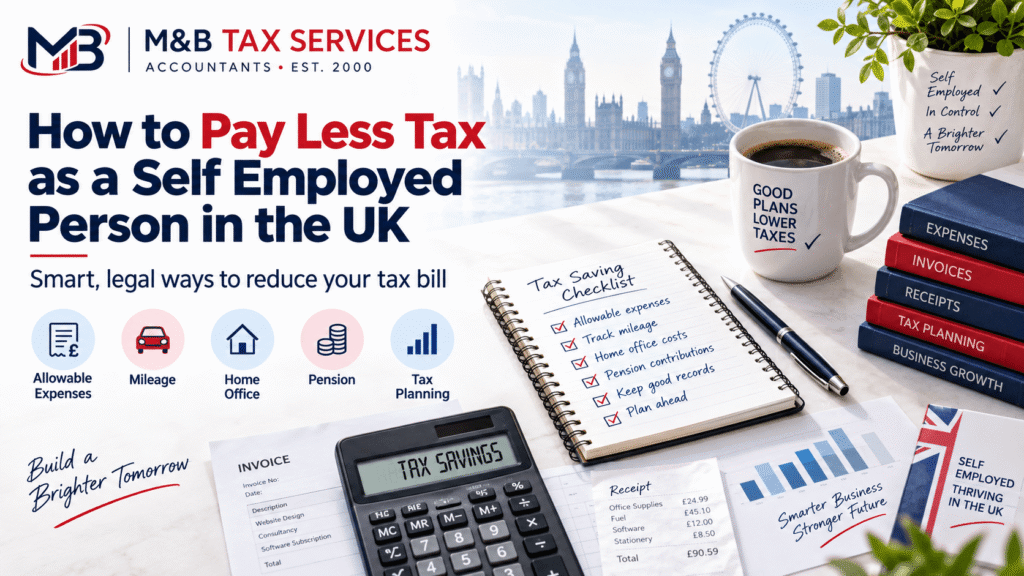
Every self-employed person in the UK pays tax on their profits. The lower your taxable profit, the less tax you pay. There are entirely legal ways to reduce that profit through allowable expenses, pension contributions, timing strategies, and the right business structure.
This guide covers every legitimate strategy available to self-employed people in the UK. None of these are loopholes or grey areas. All are within HMRC’s rules and used routinely by self-employed people across every sector.
1. Claim Every Allowable Expense
The single most effective way to reduce your tax bill as a self-employed person is to claim every allowable business expense. Many self-employed people significantly underclaim, particularly in categories they are less familiar with.
Commonly missed expenses include:
- Home office costs: a proportion of rent or mortgage interest, council tax, utilities, and broadband based on the space and time used for work
- Mileage: 45p per mile for the first 10,000 miles, 25p per mile after that, for every business journey using your own vehicle
- Phone and broadband: the business proportion of your personal phone and broadband bills
- Professional subscriptions: trade body memberships, professional journals, and industry publications directly relevant to your work
- Training and CPD: courses that update or improve skills you already use in your current business
- Accountancy fees: the cost of having your Self Assessment return prepared is itself a deductible expense
- Pre-trading expenses: costs incurred up to seven years before you started trading that would have been allowable had you already been trading
Every £100 of additional expenses you legitimately claim reduces your taxable profit by £100. At the basic rate that saves £20 in Income Tax and around £9 in Class 4 NI. At the higher rate it saves £40 in Income Tax on top of that.
2. Make Pension Contributions
Pension contributions are one of the most powerful tools for reducing self-employed tax. Contributions to a personal pension (such as a Self Invested Personal Pension or SIPP) attract tax relief at your marginal rate.
Here is how the tax relief works:
| Tax Band | Your Contribution | HMRC Adds | Total in Pension |
| Basic rate (20%) | £800 | £200 basic rate relief added automatically | £1,000 |
| Higher rate (40%) | £800 | £200 basic rate relief added, £200 claimed via Self Assessment | £1,000 (total relief £400) |
| Additional rate (45%) | £800 | £200 basic + £250 claimed via Self Assessment | £1,000 (total relief £450) |
Basic rate relief is added automatically by the pension provider. Higher and additional rate relief is claimed through your Self Assessment return. This means higher rate taxpayers get 40p of tax relief for every £1 contributed, making pension contributions exceptionally efficient at that income level.
The annual pension contribution limit (the annual allowance) is £60,000 in 2024/25 or 100% of your earnings, whichever is lower. Contributions above this limit do not receive tax relief and attract a charge.
3. Use the Trading Allowance
If your self-employment income is £1,000 or less in a tax year, the trading allowance means you pay no tax on it and do not need to report it to HMRC. The £1,000 allowance is applied to gross income before expenses.
If your income is above £1,000, you have a choice: claim the £1,000 allowance as a flat deduction, or claim your actual allowable expenses. Whichever gives the lower taxable profit is better. For very low-cost businesses with minimal expenses, the trading allowance can be the simpler option.
4. Time Your Income and Expenses Strategically
The timing of income and expenses within the tax year can affect your tax bill, particularly if your income fluctuates or you expect to move between tax bands from one year to the next.
Defer income
If you expect your income to be lower in the following tax year, deferring an invoice until after 5 April means the income falls in the next tax year. This is only effective if it genuinely delays payment rather than just delaying the invoice date, and must reflect a real commercial arrangement.
Accelerate expenses
If you plan to buy equipment or make other significant business purchases, doing so before your accounting year end brings the deduction into the current year’s tax return. For higher earners in the current year who expect lower income next year, this reduces the current year’s tax at a higher rate.
Capital allowances timing
The Annual Investment Allowance allows you to deduct the full cost of qualifying equipment in the year of purchase. Buying equipment just before your year end rather than just after means you get the deduction a full year earlier.
5. Consider Your Business Structure
If your self-employment profits consistently exceed £30,000 to £35,000 per year, incorporating as a limited company may reduce your overall tax bill.
As a limited company director, you pay Corporation Tax (19% to 25%) on company profits rather than Income Tax (up to 45%) on your personal profits. You then pay yourself a combination of salary and dividends, with dividends taxed at lower rates than employment income and not subject to National Insurance.
| Income Level | Approximate Tax as Sole Trader | Approximate Tax as Ltd Company Director | Potential Saving |
| £35,000 profit | £6,500 | £5,500 | ~£1,000 |
| £50,000 profit | £12,500 | £7,500 | ~£5,000 |
| £80,000 profit | £27,000 | £18,000 | ~£9,000 |
These are approximate figures for illustration only. The actual saving depends on your specific circumstances, whether you take all profits out or retain some in the company, and accountancy costs. Ask an accountant to model the numbers for your specific income level before deciding to incorporate.
6. Claim Capital Allowances on Equipment
When you buy equipment, tools, or technology for your business, you can claim capital allowances rather than deducting it as an expense. The Annual Investment Allowance (AIA) lets you deduct the full cost of qualifying assets up to £1,000,000 in the year of purchase.
For most self-employed people, the AIA means buying business equipment gives you an immediate full deduction against taxable profit. A £5,000 laptop and camera setup purchased for a self-employed photographer reduces their taxable profit by £5,000 in that year.
7. Carry Back Losses
If your business makes a loss in a tax year, you have several options for how to use that loss to reduce tax:
- Carry the loss forward and offset it against future self-employment profits
- Offset the loss against other income in the same tax year, such as employment income or rental income
- Carry the loss back and offset it against self-employment profits from the previous tax year, potentially generating a tax repayment
In your first four years of trading, there are additional rules that allow losses to be carried back further. If your business has made a loss, speak to an accountant about which use of that loss gives the most tax-efficient outcome.
8. Claim the Marriage Allowance if Eligible
If you are married or in a civil partnership and one partner has income below the personal allowance (£12,570 in 2024/25) while the other pays basic rate tax, the Marriage Allowance allows the lower-earning partner to transfer £1,260 of their personal allowance to the higher-earning partner.
This reduces the higher earner’s taxable income by £1,260 and saves up to £252 in Income Tax per year. It is a simple and often overlooked saving for self-employed people whose income varies and who have a lower-earning spouse or civil partner.
Frequently Asked Questions
What is the most effective way to reduce self-employed tax in the UK?
For most self-employed people, a combination of claiming all allowable expenses and making pension contributions gives the greatest tax reduction. Expenses reduce taxable profit directly. Pension contributions attract tax relief at your marginal rate, effectively giving you a government top-up on every pound you save for retirement.
Is it legal to reduce my self-employed tax bill?
Yes. Every strategy in this guide is within HMRC’s rules. Claiming allowable expenses, contributing to a pension, using the trading allowance, and structuring your business efficiently are all legal and expected forms of tax planning. Tax avoidance schemes that artificially create deductions or hide income are different and carry serious legal and financial risks.
At what income level should I consider incorporating as a limited company?
Most accountants suggest incorporation becomes financially worthwhile when your annual profits consistently exceed £30,000 to £35,000. Below that level, the tax savings are often outweighed by the additional accountancy costs and administrative burden of running a limited company. An accountant can model the specific breakeven point for your situation.
Can I reduce my tax bill by paying my spouse?
You can employ your spouse or partner and pay them a salary for genuine work they carry out for your business. The salary must reflect the work done and be commercially justifiable. HMRC scrutinises payments to connected persons carefully. If your business is a limited company, you can also consider issuing shares to a spouse, though this also attracts HMRC scrutiny if it appears to be purely a tax-minimisation arrangement.
How much can I contribute to a pension as a self-employed person?
You can contribute up to £60,000 per year or 100% of your net relevant earnings (whichever is lower) and receive tax relief on those contributions. If you have unused allowance from the previous three tax years, you may be able to carry forward and contribute more in the current year. Contributions above the annual allowance do not attract relief and attract a tax charge.
Pay Less Tax With M&B Tax Services
M&B Tax Services helps self-employed people across the UK reduce their tax bill legally. We review your expenses, advise on pension contributions, assess whether incorporation makes sense for your income level, and prepare your Self Assessment return to make sure every available deduction is claimed.
We are ICB-regulated accountants based in Rugby. Most clients who switch to us from DIY Self Assessment find their tax bill falls by more than our fee in the first year.
Book a free 30-minute call and we will review your current tax position and identify every legitimate saving available to you.

Joanna Bruty
- On this page