
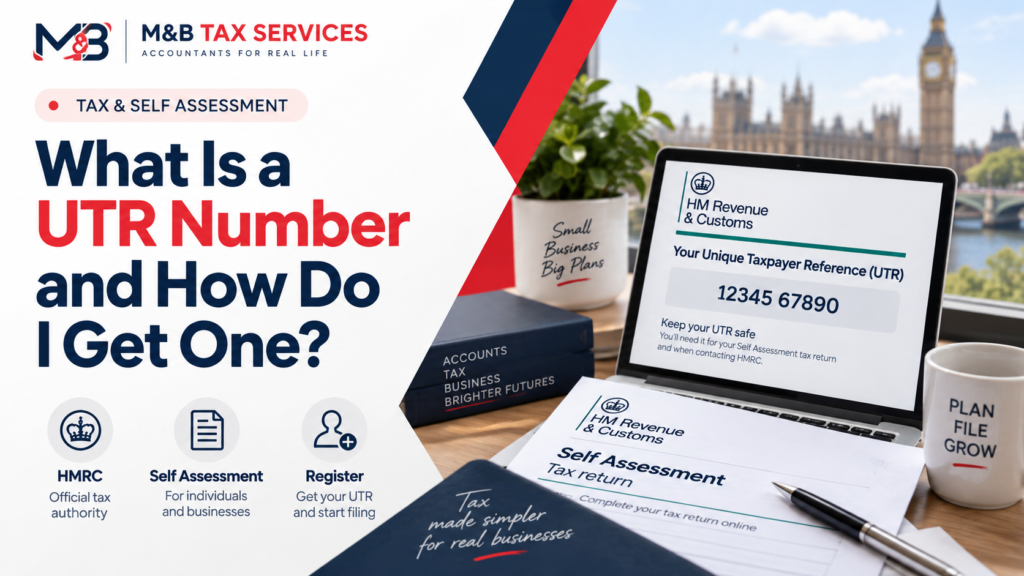
A UTR number is a Unique Taxpayer Reference. It is a 10-digit number that HMRC uses to identify you for tax purposes. Every person or business that files a Self Assessment tax return or is registered for Corporation Tax has one.
Your UTR is personal to you and stays the same throughout your life, regardless of how many times you move address, change jobs, or start new businesses. It is one of the most important reference numbers in your tax dealings with HMRC.
Who Needs a UTR Number?
You need a UTR if you are required to file a Self Assessment tax return. This includes:
• Self-employed sole traders
• Partners in a business partnership
• Limited company directors
• Landlords with rental income above £1,000 per year
• Employees with untaxed income above £2,500 (such as dividends or savings interest)
• Anyone who received a notice from HMRC to file a Self Assessment return
• CIS subcontractors registered under the Construction Industry Scheme
| Limited companies also have their own separate UTR, which is different from the director’s personal UTR. The company UTR is used for Corporation Tax returns and is issued to the company’s registered office address shortly after incorporation. |
What Does a UTR Number Look Like?
A UTR is always 10 digits long. It looks like this: 1234567890. It may also appear with a K at the end in some HMRC correspondence (1234567890K), but the core reference is always the 10 digits.
You will find your UTR on:
• The letter HMRC sent when you first registered for Self Assessment
• Any Self Assessment correspondence from HMRC, including notices to file and tax calculations
• Your Self Assessment tax return
• Your HMRC online account under Self Assessment
• Any payment reminders from HMRC related to Self Assessment
How to Get a UTR Number
Your UTR is issued automatically by HMRC when you register for Self Assessment. The process depends on your situation:
If you are self-employed
Step 1. Register as self-employed with HMRC at gov.uk/register-for-self-assessment. You can do this online through your Government Gateway account.
Step 2. HMRC sends your UTR by post to your registered address within 10 working days. If you are overseas, it can take up to 21 days.
Step 3. HMRC also sends your online account activation code separately. You need both to access your Self Assessment online account.
If you are a limited company director
When your limited company is incorporated, Companies House notifies HMRC automatically. HMRC then issues a UTR for the company to the registered office address. As a director, you also need a personal UTR to file your own Self Assessment return. If you do not already have one, register for Self Assessment as an individual through your Government Gateway account.
If you are a CIS subcontractor
You need a personal UTR before you can register for CIS. If you do not have one, register for Self Assessment first. Once you have your UTR, you can register for CIS online or by calling HMRC’s CIS helpline on 0300 200 3210.
If you have a limited company
Your company’s UTR is issued automatically by HMRC after incorporation and sent to the company’s registered office address. It is separate from your personal UTR and is used exclusively for Corporation Tax purposes.
How Long Does It Take to Get a UTR?
| Registration Method | Typical Time to Receive UTR |
| Online registration (UK address) | 10 working days by post |
| Online registration (overseas address) | Up to 21 days by post |
| Phone registration | 10 working days by post |
| Limited company (automatic from Companies House) | 2 to 4 weeks after incorporation |
HMRC does not currently issue UTRs by email or phone. It is always sent by post to the address you registered with. If you have not received it after the expected timeframe, contact HMRC on 0300 200 3310.
Register early if you have a tax deadline coming up If
you are new to Self Assessment and have a deadline approaching, register as soon as possible. The 10-working-day postal period means leaving it until January is risky. You also need to register by 5 October following the end of the tax year in which you first received untaxed income to avoid a late registration penalty.
What to Do if You Have Lost Your UTR
If you have lost or forgotten your UTR, you can find it in several places:
• Log in to your HMRC online account at gov.uk and look under Self Assessment — your UTR is shown on the main Self Assessment page
• Check any previous Self Assessment correspondence from HMRC, including tax returns, payment reminders, or notices to file
• Ask your accountant — if you use an accountant they will have your UTR on file
• Call HMRC on 0300 200 3310 and they will confirm your UTR after verifying your identity
HMRC will not give your UTR to a third party without your authorisation. If your accountant needs your UTR, they should either ask you directly or request authorisation to access your HMRC record through the agent authorisation process.
UTR vs NI Number vs Company Registration Number
| Reference | What It Is | Who Has One | Used For |
| UTR (Unique Taxpayer Reference) | 10-digit number issued by HMRC | Anyone registered for Self Assessment or Corporation Tax | Self Assessment returns, Corporation Tax, CIS |
| National Insurance number | 2 letters, 6 numbers, 1 letter (e.g. AB123456C) | All UK residents with the right to work | right to work NI contributions, employment records, state benefits |
| Company Registration Number | 8-digit number issued by Companies House | All UK limited companies and LLPs | Companies House filings, statutory documents |
You may need all three of these references at different points. Your UTR is for HMRC tax purposes, your NI number is for National Insurance and employment records, and your company registration number is for Companies House filings.
Frequently Asked Questions
Can I start working as self-employed before I receive my UTR?
Yes. You can start working as self-employed before your UTR arrives. However, you must register for Self Assessment and notify HMRC that you are self-employed as soon as possible and no later than 5 October following the end of your first tax year of trading. You will need your UTR when you come to file your first Self Assessment return.
Is a UTR the same as a tax reference number?
UTR and Unique Taxpayer Reference are the same thing. You may also see the term Self Assessment reference used, which refers to the same 10-digit number. Your employer’s PAYE reference is a different number and is not the same as a UTR.
Do I need a UTR if I am employed and pay tax through PAYE?
Not unless you also have untaxed income above certain thresholds or HMRC has sent you a notice to file a Self Assessment return. Employees who pay all their tax through PAYE and have no other income sources do not need a UTR.
Can I have more than one UTR?
As an individual, you have one personal UTR throughout your life. If you also run a limited company, the company has its own separate UTR. If you are a partner in a business partnership, the partnership also has its own UTR in addition to your personal one.
What happens if I give the wrong UTR to my contractor for CIS purposes?
If you give an incorrect UTR to a contractor, HMRC cannot verify you and the contractor will deduct 30% from your payments instead of the standard 20%. Always double-check your UTR before giving it to a contractor. Your UTR is on any Self Assessment correspondence from HMRC or in your HMRC online account.
Need Help Getting Started With Self Assessment?
M&B Tax Services helps new and existing clients register for Self Assessment, obtain their UTR, and file accurate tax returns from their first year of trading. We handle the process from start to finish so you can focus on your business.
We are ICB-regulated accountants based in Rugby. If you are new to Self Assessment or unsure whether you need to register, we can confirm your position and get everything set up correctly. Book a free 30-minute call and we will walk you through exactly what you need to do.

Joanna Bruty
- On this page