
If you work in construction as a subcontractor, you have probably heard both terms. CIS and Self Assessment are two separate systems, but they are connected. Getting confused between the two is one of the most common reasons subcontractors end up with unexpected tax bills or miss out on refunds.
This guide explains what each system does, how they relate to each other, and exactly what you need to do as a self-employed subcontractor.
What Is CIS?
The Construction Industry Scheme (CIS) is a HMRC system that controls how contractors pay subcontractors in the construction industry. Under CIS, contractors deduct either 20% or 30% from the labour portion of subcontractor payments and send that money directly to HMRC.
CIS deductions are not your final tax. They are advance payments made on your behalf toward your Income Tax and National Insurance bill for the year.
CIS applies throughout the year, every time a contractor pays you. It is not something you file or report yourself. Your contractor handles the deductions and submissions. Your job is to make sure you are registered with HMRC so you receive the 20% rate rather than 30%.
What Is Self Assessment?
Self Assessment is HMRC’s system for collecting tax from people whose income is not fully taxed at source through PAYE. As a self-employed subcontractor, you must file a Self Assessment tax return each year.
Your Self Assessment return is where you:
- Report your total income for the tax year
- Declare all allowable business expenses
- Record the total CIS deductions that were made from your payments
- Calculate your actual tax liability for the year
HMRC then compares what you owe against what was already deducted through CIS. If more was deducted than you owe, you receive a refund. If less was deducted than you owe, you pay the difference.
How CIS and Self Assessment Connect
Think of it this way: CIS is the collection mechanism and Self Assessment is the reconciliation.
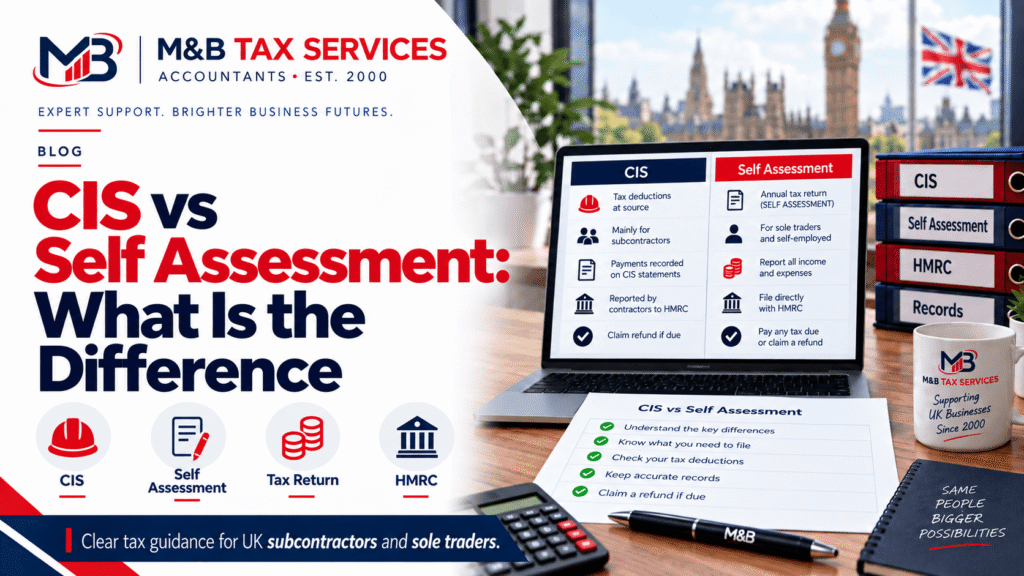
| CIS | Self Assessment | |
| What it does | Deducts tax from payments throughout the year | Calculates your actual tax liability at year end |
| Who handles it | Your contractor deducts and submits | You (or your accountant) file the return |
| When it happens | Every time you are paid | Once a year, after 5 April |
| What HMRC receives | Monthly deductions from contractors | Your annual income and expenses declaration |
| Outcome | Advance payments toward your tax bill | Final tax bill calculated and settled |
Without Self Assessment, your CIS deductions sit with HMRC indefinitely. You cannot claim a refund and HMRC cannot confirm whether you paid the right amount. Filing your Self Assessment return is what triggers the final settlement.
Do All CIS Subcontractors Need to File Self Assessment?
Yes. If you receive payments under CIS as a self-employed sole trader, you must register for and file a Self Assessment return every year.
You must register for Self Assessment by 5 October following the end of the tax year in which you first worked under CIS. For example, if you started as a CIS subcontractor in the 2024/25 tax year (which ends 5 April 2025), you must register by 5 October 2025.
Failing to register or file can result in automatic penalties from HMRC, even if you do not owe any tax.
| What about limited companies? If you work through a limited company as a CIS subcontractor, the rules are different. Limited companies do not use Self Assessment for CIS. Instead, CIS deductions are offset against the company’s PAYE liability through the Employer Payment Summary (EPS) process each month. The company director still files a personal Self Assessment return for their own income, but the company’s CIS refund is handled separately through payroll. |
What Happens if You File Self Assessment Without Declaring CIS Deductions?
If you forget to include your CIS deductions on your Self Assessment return, HMRC will calculate a tax bill as if no deductions were made. You will be asked to pay tax that has already been deducted from your payments.
This is one of the most expensive mistakes a CIS subcontractor can make. Always collect your deduction statements from each contractor you work with and enter the total CIS deductions on your return.
CIS vs Self Assessment: Key Dates
| Date | What You Need to Do |
| Throughout the year | Collect CIS deduction statements from each contractor |
| 5 April | End of the tax year |
| 5 October | Deadline to register for Self Assessment if you are new to CIS |
| 31 January | Deadline to file your Self Assessment return online and pay any tax owed |
| 31 July | Second payment on account deadline (if applicable) |
Frequently Asked Questions
Can I be registered for CIS but not Self Assessment?
You can register for CIS without being on Self Assessment, but if you are receiving CIS payments as a self-employed subcontractor, you are legally required to file a Self Assessment return. Being on CIS does not automatically register you for Self Assessment. You must do both separately.
Does filing Self Assessment mean I will owe more tax?
Not necessarily. Many subcontractors receive a refund through Self Assessment because CIS deductions throughout the year exceeded their actual tax liability. Whether you owe more or receive a refund depends on your total income, your expenses, and how much was deducted.
What if I worked for multiple contractors during the year?
You report the total income from all contractors on a single Self Assessment return. Add up all CIS payments received and all CIS deductions made across all contractors. You should have a deduction statement from each contractor for every payment they made to you.
I have not filed Self Assessment for several years. What should I do?
File the outstanding returns as soon as possible. HMRC charges automatic penalties for late returns, but these can sometimes be reduced when you come forward voluntarily. You may also be owed refunds for those years that have not yet been claimed. You can go back up to four tax years.
Is CIS only for sole traders?
No. CIS applies to sole traders, partnerships, and limited companies that work in construction as subcontractors. The way CIS deductions are reclaimed differs depending on your business structure: sole traders use Self Assessment, limited companies use PAYE offset through the Employer Payment Summary.
Need Help With CIS and Self Assessment?
M&B Tax Services handles CIS registration, Self Assessment returns, and CIS refund claims for construction subcontractors across the UK. We make sure your deductions are recorded correctly and your return is filed on time.
We are ICB-regulated accountants based in Rugby. If you are unsure whether you owe tax or are owed a refund, we can work through your CIS position and give you a straight answer.
Book a free 30-minute call and we will review your situation at no cost.

Joanna Bruty
- On this page