
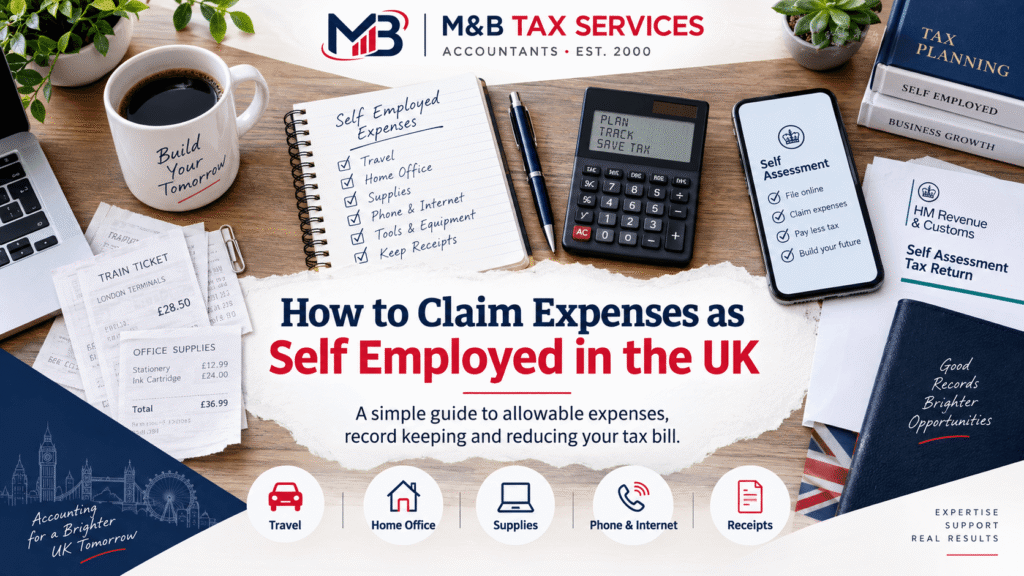
As a self-employed person in the UK, you can deduct allowable business expenses from your income before calculating how much tax you owe. The more legitimate expenses you claim, the lower your taxable profit and the less tax you pay.
Many self-employed people either overclaim (which HMRC can challenge) or underclaim (which costs them money they are entitled to keep). This guide covers every main category of allowable expense, explains the rules around each one, and tells you how to claim them on your Self Assessment return.
The Golden Rule: Wholly and Exclusively
HMRC allows expenses that are incurred wholly and exclusively for the purpose of your trade, profession, or vocation. If an expense has any personal element, only the business proportion is allowable.
For example, if you use your mobile phone 70% for business and 30% personally, you can claim 70% of the bill as a business expense. You cannot claim the full amount.
Complete List of Allowable Self Employed Expenses
1. Office costs
- Stationery, printer ink and cartridges, postage
- Computer equipment, monitors, keyboards, and accessories
- Software subscriptions used for work
- Business phone and broadband (business proportion if also used personally)
- Office furniture used exclusively for work
2. Travel costs
You can claim travel costs for journeys that are wholly for business purposes. Commuting from home to a fixed place of work is not allowable. Travel between client sites, to meetings, or to temporary workplaces is allowable.
- Mileage if using your own vehicle: 45p per mile for the first 10,000 miles, 25p per mile after that (the HMRC approved mileage rate)
- Public transport fares for business journeys: trains, buses, taxis
- Parking costs for business journeys
- Accommodation and subsistence costs for genuine business travel away from home overnight
If you use a vehicle exclusively for business, you can claim actual costs (fuel, insurance, servicing, road tax) rather than the mileage rate. If the vehicle has any personal use, the mileage rate is simpler and HMRC-approved.
3. Clothing
You can only claim for clothing that is a specialist uniform or protective clothing required for your work. You cannot claim for ordinary clothing even if you only wear it for work. Examples of allowable clothing include:
- Hi-vis vests and safety boots for construction workers
- Chef’s whites and protective aprons
- Protective overalls for tradespeople
A suit, smart shoes, or business casual clothing worn to meetings is not allowable, even if you would not wear it otherwise.
4. Staff costs
- Salaries and wages paid to employees
- Employer National Insurance contributions
- Employer pension contributions
- Subcontractor costs (if you pay other self-employed people to do work for you)
- Recruitment costs
5. Premises costs
- Rent for business premises
- Business rates
- Utility bills for business premises
- Buildings and contents insurance for business premises
- Security costs
- Maintenance and repair of business premises
6. Home office costs
If you work from home, you can claim a proportion of your household costs as a business expense. There are two methods:
| Method | How It Works | Best For |
| Flat rate (simplified expenses) | HMRC flat rates: £10/month for 25 to 50 hours per month, £18/month for 51 to 100 hours, £26/month for 101+ hours | Most straightforward, no detailed records needed |
| Actual costs method | Calculate the business proportion of rent or mortgage interest, council tax, utilities, broadband based on rooms used and hours worked | Can give a larger deduction if your home costs are high |
7. Marketing and advertising
- Website design and hosting costs
- Online advertising: Google Ads, social media advertising
- Print advertising and leaflets
- Business cards and branded materials
- Sponsorship of events directly related to your business
8. Professional and financial costs
- Accountancy fees for preparing your Self Assessment return and business accounts
- Legal fees for business contracts and disputes (not for acquiring or setting up the business)
- Bank charges on your business account
- Business insurance premiums: public liability, professional indemnity, employers liability
- Professional membership fees and subscriptions directly related to your trade
9. Training and development
You can claim training costs that update or improve skills you already use in your business. You cannot claim for training that qualifies you to do a new type of work.
- Refresher courses and CPD relevant to your current trade or profession
- Industry-specific certification renewals
- Books and publications directly relevant to your work
10. Equipment and tools
Equipment you buy for use in your business can be claimed as a capital allowance rather than a direct expense. For most self-employed people, the Annual Investment Allowance allows you to deduct the full cost of qualifying equipment in the year of purchase.
- Tools and equipment used for your trade
- Computers and laptops used for business
- Cameras and photography equipment for photographers
- Musical instruments for professional musicians
What You Cannot Claim
| Expense | Why It Is Not Allowable |
| Everyday clothing | Not wholly and exclusively for business even if worn only for work |
| Client entertaining | HMRC specifically disallows business entertainment as a deduction |
| Fines and penalties | HMRC does not allow penalties as business expenses |
| Personal food and drink | Not allowable unless staying away from home overnight on business |
| Commuting costs | Travel from home to your regular place of work is not a business expense |
| Initial training to qualify | Only post-qualification refresher and CPD training is allowable |
Simplified Expenses: The Flat Rate Option
HMRC offers a simplified expenses scheme for self-employed sole traders and partnerships. Instead of calculating the exact business proportion of certain costs, you use HMRC flat rates.
Simplified expenses are available for:
- Home office costs (as shown above)
- Vehicle costs: flat mileage rates instead of actual costs
- Business premises where you also live (such as a bed and breakfast): flat rates for private use adjustment
Simplified expenses are easier to administer but do not always give the best result. It is worth calculating both methods to see which produces the larger deduction for your specific situation.
| Keep your records HMRC can investigate Self Assessment returns up to four years after filing in most cases, and up to 20 years in cases of suspected fraud. Keep receipts, invoices, and bank statements for every expense you claim. Digital records stored in accounting software or a cloud folder are perfectly acceptable. |
How to Claim Expenses on Your Self Assessment Return
Self-employed expenses are claimed on the Self Assessment tax return in the self-employment pages (SA103). You can use either the short form (SA103S) for simple businesses with turnover below £85,000, or the full form (SA103F) for more complex businesses.
On the short form, expenses are grouped into a small number of categories. On the full form, you enter expenses in more detail across separate boxes for each category. Your accountant will allocate your expenses to the correct boxes when preparing your return.
If you use the Self Assessment online filing system directly, the expenses section walks you through each category with guidance notes for each box.
Frequently Asked Questions
Can I claim expenses before I started trading?
Yes, in some cases. HMRC allows pre-trading expenses incurred in the seven years before you started trading, provided they would have been allowable if you had already been trading at the time. Typical examples include the cost of setting up a website, buying initial stock or equipment, and professional fees incurred before launch.
Can I claim a mobile phone as a self-employed expense?
Yes, the business proportion. If your phone is used exclusively for business, you can claim the full cost. If it is used personally as well, you can only claim the percentage that relates to business use. Keep a record of how you calculated the business proportion in case HMRC asks.
Do I need receipts for every expense I claim?
Yes. HMRC expects you to have evidence for every expense claimed on your Self Assessment return. A receipt, invoice, or bank statement showing the payment is sufficient. For mileage claims, keep a mileage log showing the date, destination, purpose, and distance of each journey.
Can I claim food and drink as a self-employed expense?
Only in limited circumstances. Food and drink while travelling away from home overnight on business is allowable. Everyday meals and drinks are not, even if you are working while eating. Some businesses (such as a food writer or chef testing recipes) may be able to claim food costs as a trade-specific expense, but this is a narrow exception.
What is the difference between an expense and a capital allowance?
An expense is a cost that is fully deductible in the year it is incurred, such as stationery or insurance. A capital allowance applies to assets that have a longer useful life, such as equipment or vehicles. The Annual Investment Allowance allows most self-employed people to deduct the full cost of qualifying capital assets in the year of purchase, which achieves the same practical result as a direct expense deduction.
Make Sure You Are Claiming Everything You Are Entitled To
M&B Tax Services prepares Self Assessment returns for self-employed people across the UK. We review your income and expenditure carefully to make sure every allowable expense is claimed and your tax bill is as low as it legally can be.
We are ICB-regulated accountants based in Rugby. Most self-employed people who switch to using an accountant find their tax bill falls by more than the accountancy fee in the first year.
Book a free 30-minute call and we will review your expenses and Self Assessment position at no cost.

Joanna Bruty
- On this page