
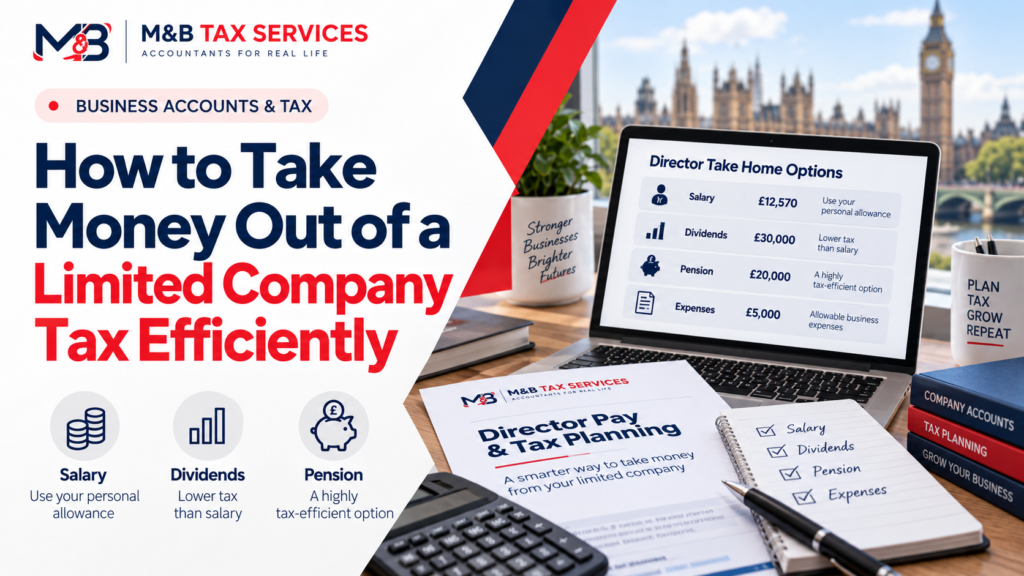
One of the biggest advantages of operating through a limited company is the ability to control how and when you take money out of the business. Done correctly, this significantly reduces the tax you pay compared to taking the same income as a salary. Done incorrectly, it costs you more than it should or creates legal problems with HMRC.
This guide covers every legitimate method for extracting money from a limited company, ranked by tax efficiency, with worked examples so you can see exactly how much each method costs you in tax.
The Methods Available to Limited Company Directors
| Method | Subject to Income Tax? | Subject to NI? | Tax Efficiency |
| Director’s salary (within personal allowance) | No | Small employer NI only | High |
| Dividends (within basic rate band) | 8.75% | No | High |
| Pension contributions (employer) | No | No | Very high |
| Expense reimbursement | No | No | Very high (but limited scope) |
| Director’s salary (above personal allowance) | 20% to 45% | Yes | Low to moderate |
| Director’s loan (repaid within 9 months) | No (if repaid) | No | Situational |
Method 1: Salary Up to the Personal Allowance
The most common starting point is paying yourself a salary up to your personal allowance, which is £12,570 in 2024/25. A salary at this level means:
- No Income Tax because the salary is covered by the personal allowance
- Small employer National Insurance on the portion above the secondary threshold (£9,100 in 2024/25)
- The salary is a deductible business expense that reduces the company’s Corporation Tax bill
The employer NI cost on a £12,570 salary is approximately £472 per year (13.8% on the £3,470 above the secondary threshold). However, because the salary reduces company profit by £12,570, the Corporation Tax saving at 19% is £2,388. The net benefit of paying this salary versus taking no salary is approximately £1,916.
Some directors set their salary at £6,396 (the Lower Earnings Limit) instead. At this level there is no employer NI at all, and the director still accrues a qualifying year for the State Pension. The trade-off is a smaller Corporation Tax deduction and a larger portion of income that must come through dividends.
Method 2: Dividends
Dividends are paid from the company’s after-tax profits. They are taxed at lower rates than salary and are not subject to National Insurance. The 2024/25 dividend tax rates are:
| Dividend Band | Total Income Level | Tax Rate |
| Dividend allowance | First £500 | 0% |
| Basic rate | Up to £50,270 total income | 8.75% |
| Higher rate | £50,271 to £125,140 total income | 33.75% |
| Additional rate | Above £125,140 total income | 39.35% |
For most directors taking a salary up to the personal allowance and the rest as dividends, the effective personal tax rate on the dividend portion is 8.75% up to the basic rate threshold. This compares favourably to the 20% Income Tax plus 8% Class 4 NI that would apply to the same income as sole trader profits.
The optimal salary and dividend combination for 2024/25
A director with no other income who wants to draw £50,000 from their company pays tax on approximately:
- £12,570 salary: zero Income Tax, approximately £472 employer NI (which the company pays)
- £500 dividends: zero tax (dividend allowance)
- £36,930 dividends at 8.75%: approximately £3,231 dividend tax
- Total personal tax approximately: £3,231
The company also pays Corporation Tax on the profits before the dividend is paid. At 19% on profits up to £50,000, this is a significant cost that must be factored into the overall picture.
| Dividends can only be paid from profitYou cannot pay a dividend if the company has no distributable profit. Paying a dividend when there is insufficient profit creates an illegal dividend, which HMRC treats as salary, making it subject to Income Tax and NI at the full rate. Always check your profit position with your accountant before declaring a dividend. |
Method 3: Employer Pension Contributions
Employer pension contributions are one of the most tax-efficient ways to extract value from a limited company. When the company contributes to your pension:
- The contribution is a deductible business expense, reducing Corporation Tax
- No Income Tax is paid on the contribution
- No National Insurance (employer or employee) is paid on the contribution
- The money grows in your pension fund tax free
For a basic rate director, a £10,000 employer pension contribution saves approximately £1,900 in Corporation Tax. The money goes into your pension rather than your pocket today, but pension funds grow tax free and you can draw from them from age 57 (rising to 58 in 2028). Up to 25% of the fund can be taken as a tax-free lump sum.
The annual pension contribution limit is £60,000 or 100% of your earnings, whichever is lower. Employer contributions count toward this limit. For higher-earning directors, pension contributions are particularly powerful because they reduce the company’s tax bill at up to 25% Corporation Tax rate.
Method 4: Expense Reimbursement
If you spend personal money on genuine business expenses, the company can reimburse you tax free. Common examples include:
- Mileage at HMRC approved rates (45p per mile for the first 10,000 miles in your own vehicle)
- Equipment purchased personally for business use
- Home office costs if you work from home and the company pays you a working from home allowance
- Training and professional subscriptions directly related to your work
Expense reimbursement is not a way to take general income from the company. It only applies to genuine costs incurred wholly and exclusively for business purposes. HMRC scrutinises expense claims from directors closely, particularly where amounts are large or recurring.
Method 5: Director’s Loan
A director’s loan is when you take money from the company that is neither salary nor a dividend. It creates a debt between you and the company that must be properly recorded and managed.
The tax treatment depends on whether and when you repay the loan:
| Scenario | Tax Consequence |
| Loan repaid within 9 months of company year end | No tax charge (but loan is still recorded and interest-free loans above £10,000 create a benefit in kind) |
| Loan outstanding after 9 months of company year end | Company pays S455 tax at 33.75% on the outstanding amount (repayable when you repay the loan) |
| Loan written off by the company | Treated as income and subject to Income Tax and NI as if it were salary |
| Interest-free loan above £10,000 | Director pays tax on the benefit of the interest saved as a benefit in kind |
Director’s loans are useful for short-term cash flow needs but are not an efficient long-term method of extracting income from the company. The S455 tax charge is significant and HMRC watches patterns of repeated loans and repayments carefully.
Combining Methods: The Most Tax-Efficient Overall Approach
For most limited company directors, the most tax-efficient overall approach combines all of the methods above:
- Pay a salary up to the personal allowance (£12,570) to use the personal allowance and reduce Corporation Tax
- Take the next £500 in dividends to use the dividend allowance
- Make employer pension contributions as the next most efficient extraction method
- Take further income as dividends, staying within the basic rate band where possible (up to £50,270 total income)
- Reimburse all genuine business expenses promptly
- Review the structure annually as your income level, the tax rates, and your personal circumstances change
Frequently Asked Questions
What is the most tax-efficient way to take money from a limited company?
For most directors, combining a salary up to the personal allowance with dividends gives the most tax-efficient result for income taken today. Adding employer pension contributions is the most efficient option for money you do not need immediately. The optimal combination depends on your income level, other income sources, and personal circumstances.
How often can I pay myself dividends from my limited company?
There is no set frequency. You can pay dividends monthly, quarterly, or as a lump sum once a year. Each dividend payment requires a board resolution and a dividend voucher. The only constraint is that you cannot pay dividends in excess of the company’s distributable profit.
Can I pay my spouse or partner dividends from my limited company?
Yes, if they are a genuine shareholder in the company. If your spouse holds shares in the company, they are entitled to receive dividends on those shares and can use their own personal allowance and dividend allowance. HMRC scrutinises share arrangements between spouses to ensure they reflect genuine commercial arrangements rather than purely tax-motivated income shifting.
What is an illegal dividend?
An illegal dividend is one paid when the company has insufficient distributable profit to support it. Distributable profit is the company’s accumulated profit after Corporation Tax. If you pay a dividend that exceeds this amount, HMRC treats it as a director’s loan or salary, making it subject to Income Tax and NI at the full rate.
Should I take a higher salary or more dividends from my limited company?
For most directors paying basic rate tax, dividends are more tax efficient than salary above the personal allowance because they are taxed at 8.75% rather than 20% Income Tax plus National Insurance. However, higher salary increases your pensionable earnings and can affect mortgage affordability assessments. The right balance depends on your individual circumstances.
Structure Your Company Withdrawals Tax Efficiently
M&B Tax Services helps limited company directors structure their salary, dividends, and pension contributions to minimise their overall tax bill. We prepare annual accounts, Corporation Tax returns, and Self Assessment returns for directors across the UK.
We are ICB-regulated accountants based in Rugby. A review of your current pay structure often reveals straightforward changes that save hundreds or thousands in tax per year.
Book a free 30-minute call and we will review your current structure and identify every available saving.

Joanna Bruty
- On this page