
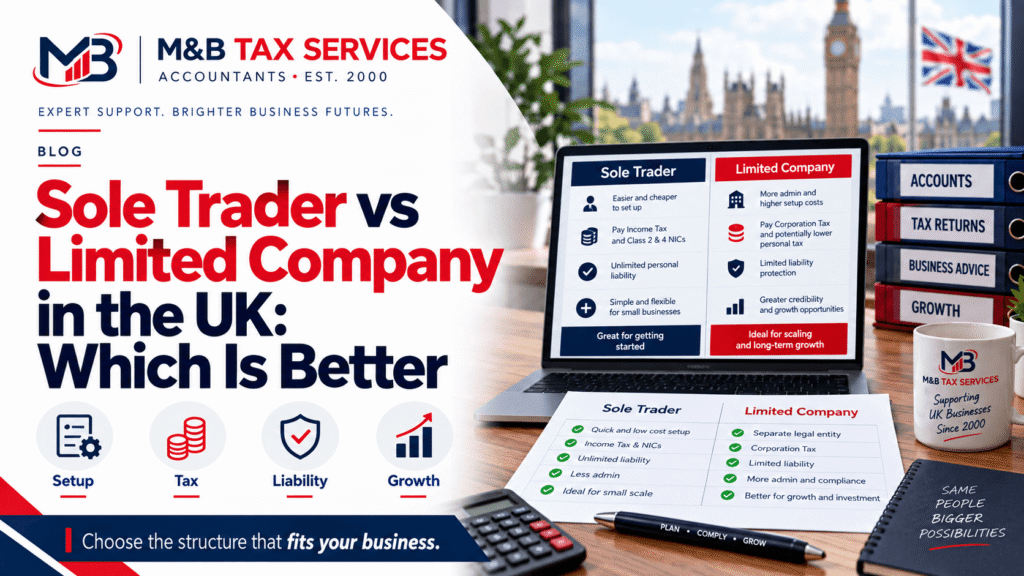
It is one of the first decisions every new business owner in the UK faces. Should you register as a sole trader, or set up a limited company?
The honest answer is: it depends on your income, your risk, and how you want to grow. There is no single right answer for everyone. But once you understand the key differences, the right choice for your situation usually becomes clear.
This guide breaks it down in plain English so you can make the right decision from the start.
What Is a Sole Trader?
A sole trader is the simplest way to run a business in the UK. You register as self-employed with HMRC, file a Self Assessment tax return each year, and pay Income Tax and National Insurance on your profits.
You and your business are legally the same entity. That means all the income is yours, but so is all the liability. If your business takes on debt or gets sued, your personal finances are on the line.
It is quick to set up, low in admin, and costs nothing to register. Most freelancers, tradespeople, and early-stage business owners start here.
What Is a Limited Company?
A limited company is a separate legal entity from you as an individual. You register it with Companies House, it has its own bank account, its own tax obligations, and its own legal identity.
As a director and shareholder, your personal liability is limited to the value of your shares. If the company fails, creditors cannot come after your personal assets in most circumstances.
Limited companies pay Corporation Tax on profits rather than Income Tax. Directors typically pay themselves a combination of salary and dividends, which can be more tax-efficient at higher income levels.
The trade-off is more admin. You must file annual accounts with Companies House, submit a confirmation statement each year, run payroll if you take a salary, and keep more detailed financial records.
Side by Side: Key Differences at a Glance
| Sole Trader | Limited Company | |
| Setup | Register with HMRC as self-employed | Register with Companies House (£50 online) |
| Tax on profits | Income Tax at 20%, 40%, or 45% | Corporation Tax at 19% to 25% |
| National Insurance | Class 2 and Class 4 NI | Employer and employee NI on salary |
| Personal liability | Unlimited — personal assets at risk | Limited to shares held |
| Privacy | Business finances are private | Accounts filed publicly at Companies House |
| Credibility | Seen as smaller/personal | Often viewed as more professional |
| Admin burden | Low — Self Assessment only | Higher — annual accounts, confirmation statement, payroll |
| Taking money out | Draw from business account freely | Salary plus dividends (more tax efficient above £50k) |
| VAT | Register when turnover exceeds £90k | Register when turnover exceeds £90k |
| Losses | Offset against other personal income | Carried forward against future profits only |
Tax: Where the Real Difference Lies
Tax is where the sole trader vs limited company decision matters most. The numbers below are based on 2024/25 rates.
As a sole trader
You pay Income Tax on profits above your personal allowance of £12,570:
- Basic rate: 20% on profits between £12,571 and £50,270
- Higher rate: 40% on profits between £50,271 and £125,140
- Additional rate: 45% on profits above £125,140
You also pay Class 4 National Insurance at 6% on profits between £12,570 and £50,270, and 2% above that.
As a limited company director
The company pays Corporation Tax on its profits:
- 19% on profits up to £50,000
- 25% on profits above £250,000
- Marginal relief applies between £50,000 and £250,000
You then pay yourself a salary through PAYE and take additional income as dividends. Dividends are taxed at lower rates than salary:
- Basic rate dividend tax: 8.75%
- Higher rate dividend tax: 33.75%
- Additional rate dividend tax: 39.35%
For most directors paying themselves a small salary (around £12,570) and taking the rest as dividends, the combined tax burden is lower than it would be as a sole trader at the same profit level.
At what profit level does a limited company become more tax efficient?
As a rough guide, a limited company typically becomes more tax efficient when your business profits consistently exceed £30,000 to £35,000 per year. Below that level, the tax savings are often outweighed by the additional accountancy and admin costs.
Liability: What Happens if Things Go Wrong?
This is the other big factor, and it is often overlooked by new business owners.
As a sole trader, you are personally liable for everything your business owes. If a client sues you, if a supplier takes you to court, or if your business runs into debt, your personal savings, your car, and in extreme cases your home could be at risk.
As a limited company director, your liability is limited to the value of your shares. If the company owes money it cannot repay, creditors pursue the company, not you personally. The exception is if you have given a personal guarantee on a loan or acted wrongfully as a director.
If you work in a field with meaningful professional risk, such as construction, consulting, or any client-facing service, the limited liability protection of a limited company is worth taking seriously.
Admin and Running Costs
Being a sole trader is much lower admin. Your main obligations are:
- Register as self-employed with HMRC
- File a Self Assessment tax return each year by 31 January
- Keep records of income and expenses
- Register for VAT if turnover exceeds £90,000
A limited company requires considerably more:
- Register with Companies House (£50 online)
- File annual accounts with Companies House
- Submit a Corporation Tax return to HMRC
- File a confirmation statement every year
- Run payroll if you take a salary
- File a Self Assessment return as a director
- Maintain a registered office address
Most limited company directors use an accountant to handle this. If you factor in accountancy costs of £800 to £1,500 per year, you need your tax savings to exceed that before the limited company option makes financial sense.
Which Should You Choose?
| Choose sole trader if: You are just starting out and want to keep things simpleYour annual profits are below £30,000You have low business risk and no clients who could sue youYou want minimal admin and no accountancy costsYou are testing a business idea before committing |
| Choose limited company if: Your annual profits are consistently above £30,000 to £35,000You want to limit your personal liabilityYou work with corporate clients who prefer dealing with a limited companyYou plan to grow, take on staff, or bring in investorsYou want to retain profits in the business and draw them down over time |
Can You Switch Later?
Yes. Many business owners start as a sole trader and incorporate later when their income justifies it. The process involves registering a new limited company, transferring the business across, and notifying HMRC.
There are tax implications when you transfer assets or goodwill to a new company, so it is worth getting advice before you make the switch rather than after. An accountant can model the numbers for your specific situation and tell you exactly when the right time to incorporate is.
Frequently Asked Questions
Is it better to be a sole trader or limited company in the UK?
It depends on your profit level, your risk exposure, and your plans for the business. Sole trader is simpler and costs less to run. A limited company becomes more tax efficient when profits consistently exceed £30,000 to £35,000 and offers personal liability protection that a sole trader does not.
How much does it cost to set up a limited company in the UK?
Registering a limited company with Companies House costs £50 online and takes around 24 hours. Ongoing costs include accountancy fees (typically £800 to £1,500 per year for a small company), Companies House filing fees, and payroll costs if you take a salary.
Do I need an accountant as a sole trader?
You do not legally need one, but many sole traders use an accountant to file their Self Assessment return and make sure they are claiming all allowable expenses. A good accountant usually saves more than they cost.
Can a sole trader have employees?
Yes. A sole trader can employ staff. You would need to register as an employer with HMRC and run payroll through the PAYE system. Being a sole trader refers to your legal and tax structure, not how many people work for you.
What is the main disadvantage of a limited company?
The main disadvantages are the additional admin burden and the cost of maintaining the company. You must file annual accounts, a Corporation Tax return, a confirmation statement, and run payroll. Most directors outsource this to an accountant, which adds to running costs.
When should I switch from sole trader to limited company?
Most accountants recommend making the switch when your annual profits consistently exceed £30,000 to £35,000, when you need the liability protection, or when corporate clients require you to operate as a company. Speak to an accountant before switching as there are tax implications to consider.
Not Sure Which Structure Is Right for You?
M&B Tax Services helps new and growing businesses across the UK choose the right structure from day one. We handle company formation, Self Assessment, Corporation Tax, and everything in between.
We are ICB-regulated accountants based in Rugby. We give you a straight answer on which structure makes more financial sense for your situation, with the numbers to back it up.
Book a free 30-minute call and we will work through it with you.

Joanna Bruty
- On this page